February 10, 2010

HSE launch Pledge Forum


The HSE has created a new Pledge Forum which basically encourages companies and organisations to adjust their working practices and reduce health and safety risks.

Any company signing up to the Pledge agree to the following:

  • Agree to play our part in reducing the numbers of work-related deaths, injuries and ill-health in Great Britain.

  • Call on employers to put health and safety at the heart of what they do and to take a common sense approach to health and safety.

  • Commit to debunking myths around health and safety that trivialise the impact of injuries, ill health and deaths on individuals and their families.

  • Recognise the importance of health and safety in difficult economic times and the dangers of complacency.

  • Pledge to work with the Health and Safety Executive and its partners to Be Part of the Solution.


Over 1000 companies are thought to have already signed up and the number is growing.

There is also a wealth of information available on the Pledge Forum website including strategy videos, media pack, toolkits, and case studies. You can also view what the HSE see as the benefits to taking part.

February 9, 2010

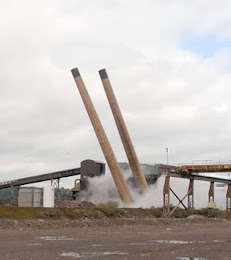
Chimney demolition, Lafarge Cement Factory, Northfleet


The above chimney demolition was carried out at the Lafarge Cement Factory, Northfleet, Kent. It forms part of what is thought to be the largest demolition site in Europe covering 34 hectares and over 70 buildings.

The demolition is being carried out by Erith Group, but the chimney was demolished by PDC.

PDC will be at the Royal Armouries, Leeds IDE Seminar on March 5th giving a presentation if you want to have a chat with them. Check out the IDE Activities Diary for more details and to book your place.

Farmer loses bid to save secret castle from demolition


In order to build pretty much anything in the UK you need to have planning permission. If that building happens to be a castle, then attempting to erect it without permission is going to be tough as it's quite noticeable on the skyline.

Robert Fidler, a 60-year-old farmer from Surrey, not only managed to build a castle without permission, he hid it from view for four years.

The castle formed a luxury home for the farmer, but no planning permission was sought. Instead, he decided to hide it behind a large wall of hay bales. It was completed in 2002 and Fidler and his family moved in.


In 2006 Fidler made the mistake of deciding to move the wall of hay and expose the castle. Sure enough, less than a year later and the council were demanding it be demolished. Fidler appealed, but that has been rejected and now it looks as though the castle is coming down.  

Source: Mail Online

February 8, 2010

Implosion of Rydges Hotel in Doha, Qatar


The video above shows the implosion of the Rydges Hotel in Doha, Qatar. The demolition involved our good friend Dick Green of Independent Explosives Engineers Ltd. We also featured Dick on the site in November last year covering his article in Construction Magazine.

The actual implosion was carried out by Dykon Explosive Demolition Corp.

Les Hemmings achieves CDM Co-ordinator status


We are pleased to announce that our own Les Hemmings has become a full member of the Association of Project Safety. This means he can now act as a CDM Co-ordinator and C&D Consultancy has three members of staff qualified for such a role.

Well done, Les!

Demolition News interview with Richard Dolman

Demolition News has an exclusive two-part interview up with AR Demolition's Richard Dolman.

The focus is on "all-risk contracts" and the concerns that brings up for AR Demolition and demolition contractors in general.

We've included both parts below:


February 5, 2010

Is this the UK's largest demolition machine?


UPDATE: As Mark points out in the comments and in his post on Demolition News. This clearly isn't the biggest, so maybe the suggestion was this is the biggest Komatsu available.

The machine you see in the image above is a Komatsu PC800-8LC. It was built especially for Lee Group by Kocurek and cost a staggering £1 million.

As the Building.co.uk website states:

"It features a 45m boom onto which grapples, shearing devices, claws and buckets can be fitted. It has an extended undercarriage and a track base which widens hydraulically for extra stability."

Have you seen bigger or does this take the top spot?

Source: Building.co.uk

Continuous Personal Development (CPD) – Am I Bovvered?

Now that you have achieved membership of your desired institution you may feel that CPD is something that you are not bothered about. However I would say that, to be not bothered is a major mistake as more and more clients are now seeking proof of, not only membership of institutes such as The Institute of Demolition Engineers, but proof of CPD within the institute and in your working life.

As you will be asked for proof of CPD throughout 2010 and beyond why not decide now to make CPD one of your goals for this year. Attend as many seminars or training days that you can, record your attendance and use those records to prove your CPD.

The CPD record will allow you to demonstrate to potential clients that you take institute membership seriously, that your industry knowledge is up to date and that you are dedicated to your status as an institute member.

With two major seminars a year and numerous regional meetings the opportunity to obtain IDE CPD points has never been better so make a decision to attend as many as possible and keep recording those points as “Points make competence”.

Safedem's Broomview House, Edinburgh demolition


C&D customer Safedem, who won the explosive demolition award at the Demolition Awards 2009, did so due to their work on the 12-storey Broomview House flats in Edinburgh.

The demolition proved to be quite complex and Demolition & Recycling International have a great review of the project. Here's an excerpt:

"The vertical columns that effectively carried the suspended floor slabs were only 200 x 500 mm (8 x 20 in) on plan, each with two vertical tendons housed within 100 mm (4 in) metal sheaths. This configuration prohibited standard drilling for explosives, so Safedem developed an innovative technique for the placement of light explosive charge weights required to disrupt the column and release the energy within the tendons at predetermined locations. This involved diamond saw cutting of vertical slots, positioned to avoid the prestressed tendons. The slots, 14 mm (0.6 in) wide and 106 mm (4.2 in) deep, allowed the 12 mm (0.5 in) diameter detonating cord to be centrally positioned within the column. Once in position, the slots were grouted to the column face in order to contain the cord and achieve maximum coupling and efficiency of the explosive charge."

You can read the whole article for yourself here. Highly recommended.

Demolition of Brighton's West Pier by Dorton Group


C&D customer Dorton Group are having a smashing time at Brighton Pier. Dorton has been awarded the contract to finally clear away the fire damaged Brighton Pier and the video above is the first footage of the work being carried out.